Precision CNC Milling Service
Precision CNC Milling Services
Leland CNC provides CNC milling services for custom components that require flat surfaces, pockets, slots, holes, threads, complex contours or tight feature relationships. CNC milling is suitable for aluminum housings, stainless steel brackets, plastic fixtures, instrument components, automation plates and parts that need accurate multi-face machining.
CNC Milling Capabilities
- 3-axis CNC milling for plates, brackets, housings and general precision parts.
- 4-axis and indexed machining for multiple-side features and reduced setups.
- 5-axis support for complex surfaces, angled holes and difficult-to-hold parts.
- Thread milling, tapping, reaming, counterbores, countersinks and precision pockets.
- Prototype milling and low-volume production with finishing and inspection support.
Materials for CNC Milled Parts
Common materials include aluminum 6061 and 7075, stainless steel 303, 304 and 316L, brass, copper, titanium and engineering plastics such as PEEK, PTFE, POM and Nylon. If you are unsure which material is best, we can compare machinability, cost, tolerance stability and surface finish options before production.
DFM Notes for Milled Parts
- Avoid unnecessarily deep narrow pockets when possible.
- Use internal corner radii instead of sharp inside corners.
- Separate cosmetic surface requirements from functional tolerance requirements.
- Call out threaded holes, inserts and inspection dimensions clearly on the drawing.
- Allow practical fixture areas when the part has features on many sides.
CNC Milling FAQ
When should I choose CNC milling?
Choose CNC milling when the part has flat faces, pockets, slots, holes, complex contours or multiple precision features that cannot be produced by turning alone.
Can you finish milled aluminum parts?
Yes. Common finishing options include anodizing, hard anodizing, bead blasting, polishing and chemical conversion coating, depending on the part function and cosmetic requirement.
Need CNC milled parts? Send your drawing and STEP file for quotation and DFM feedback.
CNC Milling Precision Manufacturer
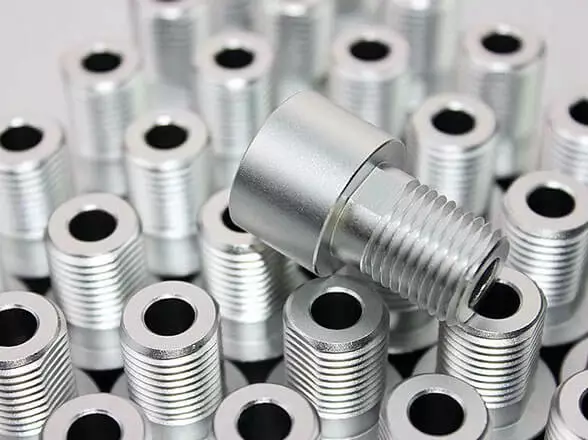
CNC turning is a reliable and efficient machining process that offers precise and consistent production of cylindrical parts, making it a fundamental technique in modern manufacturing.The process is commonly used in industries such as automotive, aerospace, medical, and general manufacturing, where cylindrical components like shafts, bolts, fittings, and connectors are required. The availability of a wide range of materials, including metals, plastics, and composites, further enhances the versatility of CNC turning.
Advantage of Precision Milling
The CNC control enables complex geometries to be machined with ease, including tapered shapes, contours, and intricate details. CNC turning also provides efficient and cost-effective production, as it can be automated for large-scale manufacturing and offers shorter lead times compared to manual turning processes.
Precise and Consistent
CNC turning machines are capable of achieving high levels of precision and accuracy. The computer-controlled nature of the process ensures that each part produced is uniform and meets the desired specifications. This consistency is crucial for maintaining product quality and functionality.
Material Selection
Lathes allow you to process a variety of materials, such as aluminum, steel, brass, titanium, plastics and composite materials. versatility allows manufacturers to consider factors, such as strength, durability, and cost. when choosing the most suitable material for their specific application.
Efficient and Fast Production
the machine is properly set up , the program is loaded, the process can run continuously, producing parts quickly and reducing overall production time. This efficiency is particularly beneficial for large production runs.
Complex Geometries and Design Flexibility
CNC machines can create intricate and complex geometries with ease. The computer-controlled process, allows for precise tool movements, enabling the production of intricate features, threads, contours, and other complex shapes. This design flexibility opens up possibilities for innovative and customized parts.
Cost-Effective Large Production Runs
CNC turning is highly cost-effective for large production runs. The automation and efficiency of the process result in reduced labor costs and increased productivity. Additionally, the ability to optimize tool paths and minimize material waste contributes to overall cost savings.
Quick Prototyping and Iteration
CNC machines can utilized for rapid prototyping. The ability to quickly produce prototypes allows for faster design iteration, testing, and refinement, reducing time to market and enabling faster product development cycles.
What is CNC Milling?
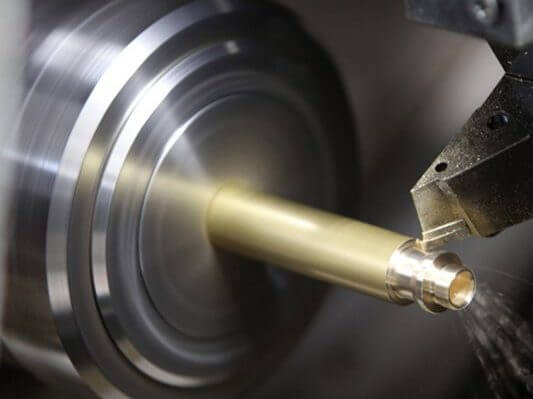
CNC turning is a particular form of precision machining in which a cutter removes material by making contact with the spinning workpiece. The movement of the machinery is controlled by computer instructions, allowing for extreme precision and repeatability.
Turning is different to CNC milling, in which the cutting tool rotates and is directed from multiple angles at the workpiece, which is usually stationary. Because CNC turning involves rotating the workpiece in a chuck, it is generally used to create round or tubular shapes, achieving far more accurate rounded surfaces than would possible with CNC milling or other processes.
The tooling that is used with a CNC lathe machine is mounted to a turret. This component is programmed to make certain movements and remove material from raw materials until the desired 3D model is formed.
Like CNC milling, CNC turning can be used for the rapid manufacture of either prototypes or end-use parts.
CNC turning plastics
Aluminum machining is a fundamental aspect of Leland services catalog, but CNC turning can also be employed to process metals such as magnesium, steel, stainless steel, brass, copper, bronze, titanium, and nickel alloy.
CNC turning is frequently utilized for mechanical and precision components, which are frequently crafted from aluminum, the most readily machinable metal. Aluminum parts can be manufactured with exceptional strength and accuracy, along with an excellent surface finish.

CNC turning plastics
While precision machining is primarily employed for metals, Leland is also proficient in offering CNC turning services for plastic parts. The materials available for CNC turning encompass nylon, polycarbonate, ABS, POM, PP, PMMA, PTFE, PEI, PEEK, among others, enabling the production of highly accurate parts compared to those produced through 3D printing methods.
Custom CNC Turning Parts for Customer

Precision Acrylic Prototype
This is a lens we did for a famous automotive lighting company. Before they reached out to 3ERP, they did testing with numbers of other prototype companies. The parts they received looked brilliant at first glance, but as soon as they go for light simulation testing, none of them were able to hit the mark.
The reason? Well, simply because the prototypes from these other services were not accurate enough. So, they thought they would have to outsource from Europe. However, when they approached the 3ERP team, the company soon discovered that they had finally found a service provider that could meet their needs.